wag-logo
Joint Dislocation in Cats
Written By hannah hollinger
Published: 09/30/2016Updated: 01/12/2022
Veterinary reviewed by Dr. Linda Simon, MVB MRCVS
What is Joint Dislocation?
Joints are held together with tendons and ligaments. When these are also damaged, the dislocation is referred to as luxation. Subluxation refers to dislocation with no damage to these surrounding parts. Hip dislocation, from hip dysplasia or from injury, along with a luxating patella (sliding knee cap) are among the most common dislocations seen in cats. Elbow luxation and tail dislocation are also seen on a lesser scale. Joint dislocations are paired most commonly with other serious injuries from trauma. It is imperative to get your cat immediate veterinary care in situations of trauma, as the injuries can be life threatening.
A joint is the point at which two or more bones meet, often allowing movement of body parts. The three types of joints; fibrous, cartilaginous and synovial pivot joints, can become pulled apart or moved out of alignment, which is known as dislocation. Joints that allow movement are at a greater risk than ones that do not. The joints that allow movement are categorized as hinge, saddle and ball, and socket joints.
Youtube Play
Joint Dislocation Average Cost
From 412 quotes ranging from $200 - $1,000
Average Cost
$500

Get a free pet insurance quote in less than 60 seconds!

Easily compare quotes from the most trusted pet insurance companies in the United States.

Get a quote

Symptoms of Joint Dislocation in Cats
Often the first symptom of trauma is your cat's disappearance for a long period of time, even lasting days, in some cases. A serious injury usually makes it difficult for the cat to return home. Inspect your cat upon its return for any possible injuries. Other symptoms to watch for are:
  • Pain
  • Holding limb up or dragging it
  • Limited or abnormal movement
  • Limping
  • Tenderness
  • Swelling
  • Decrease in muscle mass around affected joint
  • Bent limb
  • Deformed joint
  • No toe sensation
  • Hiding away
Causes of Joint Dislocation in Cats
By far, the most common cause of joint dislocation in cats is injury. Small children should be encouraged to be gentle with cats, as rough play often results in dislocation and other injuries to the cat.
Known causes include:
  • Falling from a great height
  • Being hit by an automobile
  • Being stepped on by a human
  • Tail or limb being pulled by a human
  • Fighting with another animal
  • Having a body part shut in a door (often the tail)
  • Congenital disorder (such as hip dysplasia)
Diagnosis of Joint Dislocation in Cats
Upon arrival to a veterinary clinic or animal hospital, the vet will complete a careful physical exam, evaluating the extent of the injury. They may note a grinding of the dislocated joint. X-rays will be needed to ensure that no other life-threatening trauma to the body is present, especially in the case of an altercation with a vehicle. 
A complete blood profile, biochemical profile, and urinalysis will be taken to assess the cat's overall condition. If surgery will be needed, X-rays of the chest will be required before anesthetic can be administered to rule out other injuries such as a hernia or collapsed lung.
Treatment of Joint Dislocation in Cats
The treatment for joint dislocation depends very much on the location and severity of the dislocation itself. There are surgical and nonsurgical options available, mostly contingent on the amount of time that has passed since the joint was moved out of place.
Joint Manipulation 
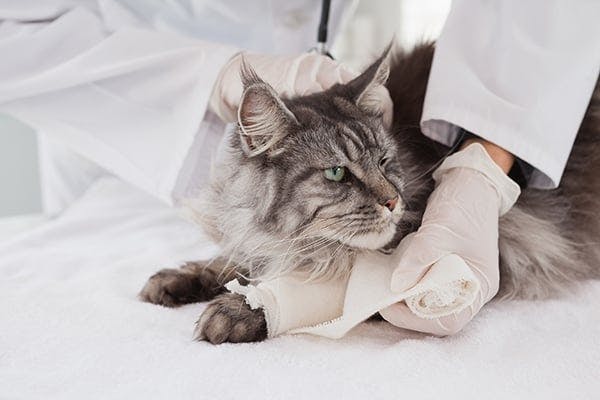
If the dislocation has happened within a few days of the veterinary visit and the severity is not too extreme, the vet may be able to use physical force to put the joint back into place. The cat will be under general anesthetic for the process as it is quite painful. An X-ray will be performed after the manipulation to verify that alignment has been corrected. Only a professional should attempt this procedure. The cat may be bandaged or otherwise immobilized while the joint heals, lasting anywhere from four to fourteen days. Cage rest may be required if the dislocation was in the hip joint. Dislocations may recur.
Surgery 
For severe dislocations, dysplasia, or dislocations where much time has passed, extensive surgery may be needed. This often includes the implantation of steel pins and screws, some which need surgical removal after the healing process. Fluoroscopy may be used to reduce incision size, but some cases require very large incisions. Nonsteroidal anti-inflammatory drugs (NSAIDs) are often prescribed after surgery to reduce inflammation. Antibiotics may also be prescribed for two to four weeks post surgery to stave off infection. 
Medication
In both surgical and nonsurgical treatments of joint dislocation, painkillers will be prescribed to help the cat get through the first few painful days and weeks of healing. 

Worried about the cost of treating your pet's symptoms?

Pet Insurance covers the cost of many common pet health conditions. Prepare for the unexpected by getting a quote from top pet insurance providers.

Get a quote

Recovery of Joint Dislocation in Cats
At-home care will continue for as long as the cat is healing, which can range from three weeks to two months. If bandages have been applied, inspect them daily to ensure they are clean and dry. They will need to be regularly changed. A comfortable, soft bed should be supplied to prevent the cat from developing bed sores. If the jaw was dislocated, soft foods will be needed throughout the healing process. Initially, some cats may need to be tube fed.
The cat will need to be kept indoors, and possibly confined to a cage to limit movement while the joint heals. Physical lay is discouraged throughout this time but cats will need plenty of socialisation and mental stimulation. Physiotherapy may be recommended to assist in strengthening the joint and surrounding muscles.
If the treatment was successful and the post treatment care has been closely followed, the cat will not likely dislocate the joint again. If proper care has not been given, the joint will continue to weaken with each dislocation. Obese cats who have suffered from joint dislocation should lose weight to take stress off of the affected joint. In many cases, no more treatment is needed after the healing process finishes. Monitor your cat’s joint in the years to come to watch for signs of injury-related arthritis development.
Joint dislocation can be expensive to treat. To avoid high vet care expenses, secure pet health insurance today. The sooner you insure your pet, the more protection you’ll have from unexpected vet costs.
Joint Dislocation Average Cost
From 412 quotes ranging from $200 - $1,000
Average Cost
$500
Top
Joint Dislocation Questions and Advice from Veterinary Professionals
mancoon
One Year

20 found this helpful

20 found this helpful

My pet has the following symptoms:
Holding Left Back Leg Up Limping Meowing Aggitated
We came home the other day from store and our indoor / mostly outdoor cat who is a larger cat,was limping his hind left leg . He was isolating himself from our puppy and ourselves. We thought he possibly been attacked but no open wounds just his leg . We've waited a couple days now and he still can't seem to lower that leg .I also had to move his dad's she's to lower grounds he's very cuddly however. I want to help him . I'm taking him to get tomorrow . What is going on and what can I do to help NOW ?
Oct. 20, 2021
Answered by Dr. Sara O. DVM
20 Recommendations
Hello there are many things that could be going on. He could have something broken or dislocated. I would keep him isolated and confined and take him to the vet tomorrow for x rays and an exam
Oct. 20, 2021
Was this question and answer helpful?
Calico Cat
One Year

12 found this helpful

12 found this helpful

My pet has the following symptoms:
Sprained Leg
swelling in the leg and limping, possible sprain can still get around and jump up on things
Sept. 26, 2020
Answered by Dr. Michele K. DVM
12 Recommendations
Thank you for your question. I apologize for the delay, this venue is not set up for urgent emails. Since I cannot see your pet, It would be best to have your pet seen by a veterinarian, as they can examine them, see what might be going on, and get treatment for them.
Oct. 15, 2020
Was this question and answer helpful?
Tabby
Three Months

11 found this helpful

11 found this helpful

My pet has the following symptoms:
Limping
He looks like he has a dislocated joint. He has been sleeping a lot recently and hasn’t moved around very much, when he does move he limps.
Aug. 3, 2020
Answered by Dr. Michele K. DVM
11 Recommendations
Thank you for your question. It sounds like your kitten may need some medical attention, and without seeing him it is hard to say what might be going on. If he is a dislocation or fracture, that is probably quite painful and should probably be fixed. Having him seen by a veterinarian will let them look at him, see what might be going on, and give you options for treatment. I hope he is okay.
Aug. 3, 2020
Was this question and answer helpful?
tabby cat
Seven Years

7 found this helpful

7 found this helpful

My pet has the following symptoms:
Limping
My cat injured her toe yesterday, she got caught on a plastic bag and made huge runs around the house trying to escape from it and her toe is hurt. She can go up and down stairs and still jump. Her toe looks out of place, dislocated? She has a regular vet appointment next week, but this might need immediate treatment... I am attaching pictures.
July 30, 2020
Answered by Jessica N. DVM
7 Recommendations
Hello- Thank you for your question. It definitely looks like there is some swelling present from the pictures but I can’t tell if it is dislocated from the picture. If she is limping a lot, the toe is becoming more swollen, or she is licking at it significantly, I would recommend getting her examined immediately. Otherwise if she is walking normally or has only a mild limp and appears comfortable you can monitor it for a few days.
July 30, 2020
Was this question and answer helpful?
Domestic shorthair
Leia
3 Months

0 found this helpful

0 found this helpful

My pet has the following symptoms:
Limping
Sad
i accidentally stepped on my kittens paw yesterday and she was limping all day yesterday. she started to put her weight on it but it still doesn't seem right. she hasn't extended her nails on that paw at all. i just took a closer look and it seems like one of her toes may be crooked. we have an appointment at the vet in two days already but I'm wondering if i should try and take her tomorrow
Sept. 25, 2018
Was this question and answer helpful?
tabby
Fiona
3 Years

0 found this helpful

0 found this helpful

My pet has the following symptoms:
Front Leg
Dislocation
Luxation
My three year old cat was outside when my mom found her crying. She wouldn't put any pressure on her front left leg, so the next morning she took her to the vet. They said it was a luxation, or dislocated but it was very bad. The surgery would be over 800 and the vet didn't seem to think it would work. Otherwise the options they gave us were to amputate, or just take her home and give her pain meds for a few weeks and she just wouldn't be able to use that leg as much anymore, but she wouldn't be in pain. Does anyone have any advice? I feel so bad for her, but I am in college and can not afford a surgery that most likely will not work and will have to spend even more money after.
short haired
Cleo
11 Weeks

0 found this helpful

0 found this helpful

My pet has the following symptoms:
Limping
Crying
Dangling Leg
My 11 week old little fell off a cabinet and right after started hissing and clawing everything. She walked away holding her leg upwards. When I picked her up her leg seemed to be dangling down more than the other. She keeps meowing, crying and can’t seem to get comfortable while trying to get some rest.
Bombay
Raven (aka broccoli)
2 Months

0 found this helpful

0 found this helpful

My pet has the following symptoms:
Pain
Limping
Meowing
Pain When Lifted.
My kitten was playing and jumped up but landed bad. She howled and later I saw her limping. She hisses or growls if I touch her left hip. It felt swollen I think it might be dislocated but I've asked second opinions and they say she relocated it. Is that possible? It doesn't feel swollen anymore and she came out of her hiding place. She's limping but still using her leg a little bit.
domestic short hair
Grey
2 Years

0 found this helpful

0 found this helpful

My pet has the following symptoms:
Limping
Didn'T Eat
Didn'T Drink
My cat age 1y6mo and weight at 7.7kg (when the injury occurred)... He became so passive and didn't eat/drink... i notice that he had limping on his right hind leg. went to the vet and the vet couldn't find any issue that time. Gave him painkiller jab n need to come again the very next day... still the same just his appetite return n eat/drink in small amount... the 2nd day get another jab n prescribed with meds for 1week observation. after a week, came back to check the injury again.. without any changes, the vet said he was fine, no pain seen on my cat face, no reaction to the pain, nothing.... so the vet suspected he had some nerve problem.... continuing the painkiller pills n some nerve pills... within a week later my husband sent my cat to another vet, n during the visit the vet also said that my cat didn't have any issue about the injured leg..... still limping n having trouble to walk, the vet seem nothing wrong with the bone, just the nerve. suggested to get an x-ray but i ask if can i continue with difference pills.... then 3 days later, my husband insisted to get my cat an x-ray..... very unfortunate, he have a fracture on his hips.... because the injury went unnoticed for quite some time, the injury seem to be healing not properly... so we opt not to have any correction surgery after we been advise that he still limping if he went under the knife...
tabby
Lucas
2 Years

0 found this helpful

0 found this helpful

My pet has the following symptoms:
Cant Move Legs
Hardly Gets Up
Hello, when I abopted my cat he was just a kitten not able to leave is mother anyways I did just discover that when my cat was still inside the womb a child had kicked the pregnant cat causing her to even losing half of her litter:( (she had 4 pups only 1 survived) scared about my cat I kept an eye on him these past few months. Realizing he walks very strange compared to my other cats; legs are sticking inwards, even when he sits the hips are in different levels so to say. He doesn’t play or move as much anymore from being a kitten. When you hold him you have to hold him a certain way, like cradling a child, can not even go near his hips. I watch his diet try and get him to atleast walk around a little bit with treats or food. My Questions are What are the best medications I can give him What can I do for him not to be in pain What can I do to make him feel comfortable And if theres anything im doing wrong or not doing please tell me. Very concerned fur mama :)
Joint Dislocation Average Cost
From 412 quotes ranging from $200 - $1,000
Average Cost
$500

Get a free pet insurance quote in less than 60 seconds!

Easily compare quotes from the most trusted pet insurance companies in the United States.

Get a quote

Need pet insurance?
Need pet insurance?